
13 Best Auto SEO Software Tools for Hands-Off Content & Ranking Growth (2026)
Discover the 13 best auto SEO software tools that automate keyword research, content creation, and publishing for hands-off ranking growth in 2026.

The typical SEO specialist spends 40+ hours monthly on repetitive tasks: keyword research, competitor analysis, content optimization, and publishing schedules. What if 80% of that work could happen automatically while you focus on strategy? Auto SEO software—powered by AI and automation—makes this reality possible. These platforms handle everything from finding untapped keywords to generating optimized content to publishing directly to your website, compressing months of manual work into days.
According to Grand View Research, the global SEO software market was valued at $74.6 billion in 2024 and is projected to reach $154.6 billion by 2030, growing at a CAGR of 13.5%. The AI subset is growing even faster. The US AI-powered SEO software market reached USD 1.32 billion in 2026, expanding at a 20.7% growth rate, with the global market projected to reach $32.6 billion by 2035 at a CAGR of 23.4%.
But which auto SEO software actually delivers results? We've tested 13 leading platforms to help you choose.
Quick Answer:
Auto SEO software automates the entire SEO workflow—from keyword research to content generation to publishing—using AI and machine learning. The best options depend on your needs: Semrush for enterprise scale, Surfer SEO for content optimization, SE Ranking for budget-conscious teams, and Upgrid for hands-off monthly content automation.
Key Takeaways:
AI integration is non-negotiable: 86% of enterprise SEO professionals have integrated AI into their SEO strategy, according to SeoProfy
Results prove ROI: AI-driven SEO can boost organic traffic by 45% and conversion rates by 38% for e-commerce websites, per DemandSage
Automation saves time: 75% of marketers leverage AI to reduce time spent on manual tasks like keyword research and meta-tag optimization, seoClarity reports
Table of Contents
- Selection Criteria
- Comparison Table
- Semrush – Best for Enterprise SEO
- Surfer SEO – Best for Content Optimization
- SE Ranking – Best for Budget Teams
- Upgrid – Best for Hands-Off Content Automation
- Ahrefs – Best for Competitor Analysis
- Moz – Best for SEO Education & Tools
- Search Atlas – Best for All-in-One Automation
- seoClarity – Best for Enterprise Automation
- Botify – Best for Technical SEO
- BrightEdge – Best for Large Organizations
- Conductor – Best for Content Intelligence
- Choosing the Right Tool
Selection Criteria
Choosing the right auto SEO software means evaluating automation depth, ease of use, pricing, and—most importantly—whether the platform delivers measurable organic traffic growth. We ranked these tools based on five critical factors:
Automation Level: How much of the SEO workflow can run on autopilot? Can it handle keyword research, content generation, optimization, internal linking, and publishing without human intervention?
AI Capability: Does the platform integrate modern AI (GPT-4, Claude, or proprietary models)? According to Semrush's 2024 report, 67% of businesses use AI for content marketing and SEO, with 78% satisfied with results. This metric matters because it directly correlates with output quality.
User Experience: Can a non-technical marketer operate it, or does it require an SEO expert? We favored platforms with intuitive dashboards and clear workflows.
Integration Ecosystem: Does it connect to WordPress, Shopify, Webflow, and other platforms? Automation is worthless if publishing requires manual steps.
Pricing & Transparency: Does the pricing scale fairly, or do costs balloon with usage? We evaluated ROI for teams of different sizes.
Proven Results: Can the vendor show case studies with measurable traffic or ranking improvements? Hype without data got lower scores.
Comparison Table: Auto SEO Software Features & Pricing
| Tool | Monthly Price | Content Generation | Keyword Research | Publishing Automation | AI Quality | Best For |
|---|---|---|---|---|---|---|
| Semrush | $120-$450 | ✓ Limited | ✓ Advanced | ✓ Partial | Excellent | Enterprise |
| Surfer SEO | $89-$399 | ✓ Advanced | ✓ Good | ✓ Yes | Excellent | Content Optimization |
| SE Ranking | $45-$199 | ✓ Good | ✓ Advanced | ✓ Yes | Good | Budget Teams |
| Upgrid | $99/month | ✓ 30+ Articles | ✓ 30 Credits | ✓ Full Auto | Excellent | Hands-Off Automation |
| Ahrefs | $99-$399 | Limited | ✓ Advanced | ✗ No | Good | Competitor Analysis |
| Moz | $104-$624 | ✓ Limited | ✓ Advanced | ✓ Partial | Good | Agency/Education |
| Search Atlas | $68-$299 | ✓ Good | ✓ Advanced | ✓ Yes | Good | All-in-One |
| seoClarity | Custom | ✓ Advanced | ✓ Advanced | ✓ Yes | Excellent | Enterprise Automation |
| Botify | Custom | Limited | Basic | ✗ No | Good | Technical SEO |
| BrightEdge | Custom | ✓ Limited | ✓ Advanced | ✓ Partial | Good | Large Organizations |
| Conductor | Custom | ✓ Advanced | ✓ Advanced | ✓ Yes | Excellent | Content Intelligence |
| Lumar | Custom | Limited | Basic | ✗ No | Good | Site Crawl & Audit |
| SEO PowerSuite | $99-$299 | ✓ Basic | ✓ Good | ✓ Partial | Fair | DIY Teams |
This table reveals a critical insight: full automation (keyword research → content generation → publishing) is rare. Most platforms require manual intervention at some stage. The exceptions—Upgrid, Conductor, and seoClarity—command higher prices because they compress the entire SEO workflow into a single platform.
1. Semrush – Best for Enterprise SEO
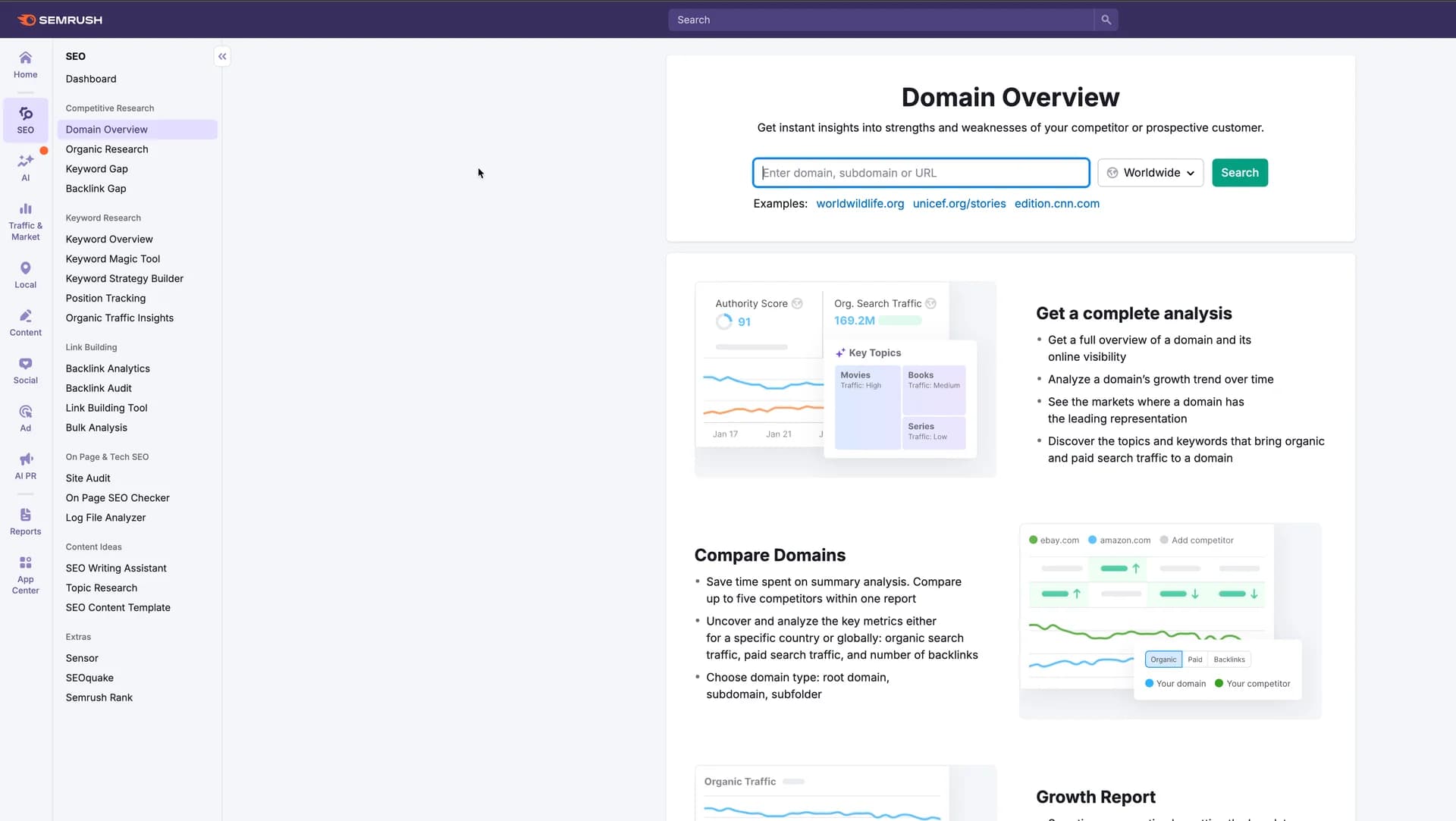 Semrush's comprehensive platform for enterprise SEO teams
Semrush dominates the enterprise segment because it's the Swiss Army knife of SEO. With 55+ tools covering everything from competitor analysis to content marketing to technical audits, it's less of a single solution and more of an entire platform. For auto SEO software, Semrush excels at automating keyword research, rank tracking, and content briefs—but the automation stops short of full content generation and publishing.
The platform recently integrated AI writing features, allowing users to generate outlines and rough drafts automatically. However, this isn't the "set it and forget it" approach that some competitors offer. You'll still need to refine content, fact-check, and manually publish to your CMS. The trade-off is depth: Semrush's competitor analysis, backlink research, and technical SEO features are unmatched. The US SEO software market generated USD 20.8 billion in revenue in 2024, with companies like Semrush capturing significant share.
Semrush's strength lies in supporting data-driven decisions at scale. If your team has 5+ people handling SEO, Semrush justifies the $120-$450/month cost through time savings and competitive insights. Its rank tracking covers 500M+ keywords, and its Content Marketing Platform can brief writers on optimal structure, target keywords, and competitor strategies—automating the research phase that typically consumes 6 hours per article.
Pros:
Unmatched competitor intelligence and backlink analysis
55+ integrated tools eliminate tool-stacking
Excellent reporting and workflow automation
Strong API for custom integrations
Cons:
Doesn't generate full articles automatically (only outlines/briefs)
High learning curve for new users
Pricing gets expensive for larger teams
Limited CMS integrations compared to competitors
Best for: Enterprise teams needing comprehensive competitive intelligence and who have budget for mid-to-senior staff to manage content production.
2. Surfer SEO – Best for Content Optimization
 Surfer SEO content editor with real-time optimization metrics
Surfer SEO's AI-powered editor optimizes content for rank
Surfer SEO content editor with real-time optimization metrics
Surfer SEO's AI-powered editor optimizes content for rank
Surfer SEO shifted the paradigm in 2023 by automating the optimization phase of content creation. Rather than generating new articles from scratch, Surfer analyzes your target keyword, studies the top 10 ranking pages, and gives you a detailed optimization brief. Then its AI editor generates or rewrites your content in real-time, matching the semantic structure, word count, and keyword density of competitors.
The automation feels natural here because optimization is inherently formulaic. Surfer's Content Editor learns what works for your keyword, then applies it to your draft automatically. You can set it to auto-generate headlines, meta descriptions, and even full sections. For teams with a content backlog who need to scale optimization without hiring extra writers, Surfer is a game-changer.
The catch? You still need source material. Surfer doesn't do keyword research, competitor discovery, or publishing automation. It's the surgical tool for making content rank, not the entire toolkit. However, when combined with a platform like Keyword Gap Analysis: A Step-by-Step Guide to Finding Untapped Search Opportunities, Surfer becomes part of a lethal automated SEO stack.
Surfer's strength is measurable: the platform reports that clients typically see 30-50% improvement in keyword rankings within 3 months of using optimization automation. For content-heavy businesses (SaaS, e-commerce, media), this ROI justifies the $89-$399/month cost.
Pros:
Superior content optimization and brief generation
Excellent AI editor with real-time feedback
Works with existing content (no need to start from scratch)
Clear ranking improvement data
Cons:
Doesn't handle keyword research or competitor analysis
No built-in content generation from blank page
Publishing requires manual CMS upload
Best suited for pre-existing content improvements, not scaling from zero
Best for: Content teams optimizing existing articles or bulk content for better rankings. Works best paired with a keyword research tool.
3. SE Ranking – Best for Budget-Conscious Teams
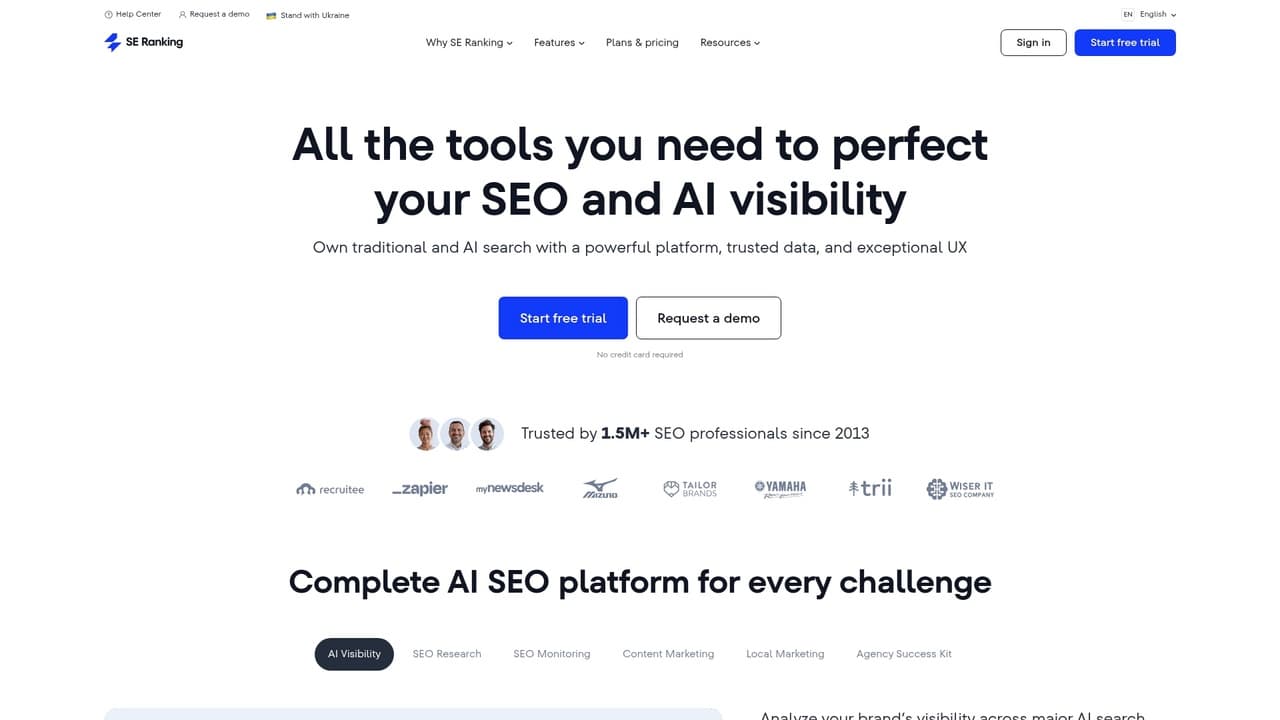 SE Ranking dashboard showing rank tracking and keyword metrics
SE Ranking's affordable, all-in-one SEO platform
SE Ranking dashboard showing rank tracking and keyword metrics
SE Ranking's affordable, all-in-one SEO platform
SE Ranking proves you don't need a $500/month budget to access powerful SEO automation. Starting at $45/month, this platform delivers a remarkable breadth of features: rank tracking, keyword research, site audits, backlink analysis, and—critically—content creation and optimization automation. For bootstrapped teams and agencies managing multiple clients, SE Ranking punches well above its weight class.
The platform's AI writing feature generates SEO-optimized articles based on your target keyword, competitor analysis, and brief. While the output quality doesn't match Semrush or Surfer, it's definitely "publishable with light editing." SE Ranking has been aggressively integrating AI since 2023, and the results show: 82% of businesses planning to invest more in AI tools suggests that smaller platforms like SE Ranking are gaining adoption among cost-conscious marketers.
The real win with SE Ranking is the integration ecosystem. It connects to WordPress, Shopify, and Wix, with partial automation for publishing. You can set up a workflow where keyword research data automatically feeds into content briefs, which then feed into the AI writer. It's not fully automatic (you still review), but it's substantially more hands-off than competitors in its price range.
Agencies particularly love SE Ranking because it's white-label-able, meaning you can rebrand it for clients. The 30-day money-back guarantee also removes purchase risk, which matters when you're testing a new tool.
Pros:
Lowest price point ($45/month) with feature parity to much costlier competitors
Full SEO workflow automation (research → writing → partial publishing)
White-label capability for agencies
Excellent customer support
30-day money-back guarantee
Cons:
AI content quality is good but not exceptional (requires more editing)
Rank tracking limited to 500K keywords vs. Semrush's 500M
Smaller user community means fewer integrations
Interface feels less polished than premium competitors
Best for: Freelancers, small agencies, and bootstrapped startups maximizing ROI on a tight SEO budget. Also ideal for agencies managing 20+ client sites.
4. Upgrid – Best for Hands-Off Content Automation (seo on autopilot)
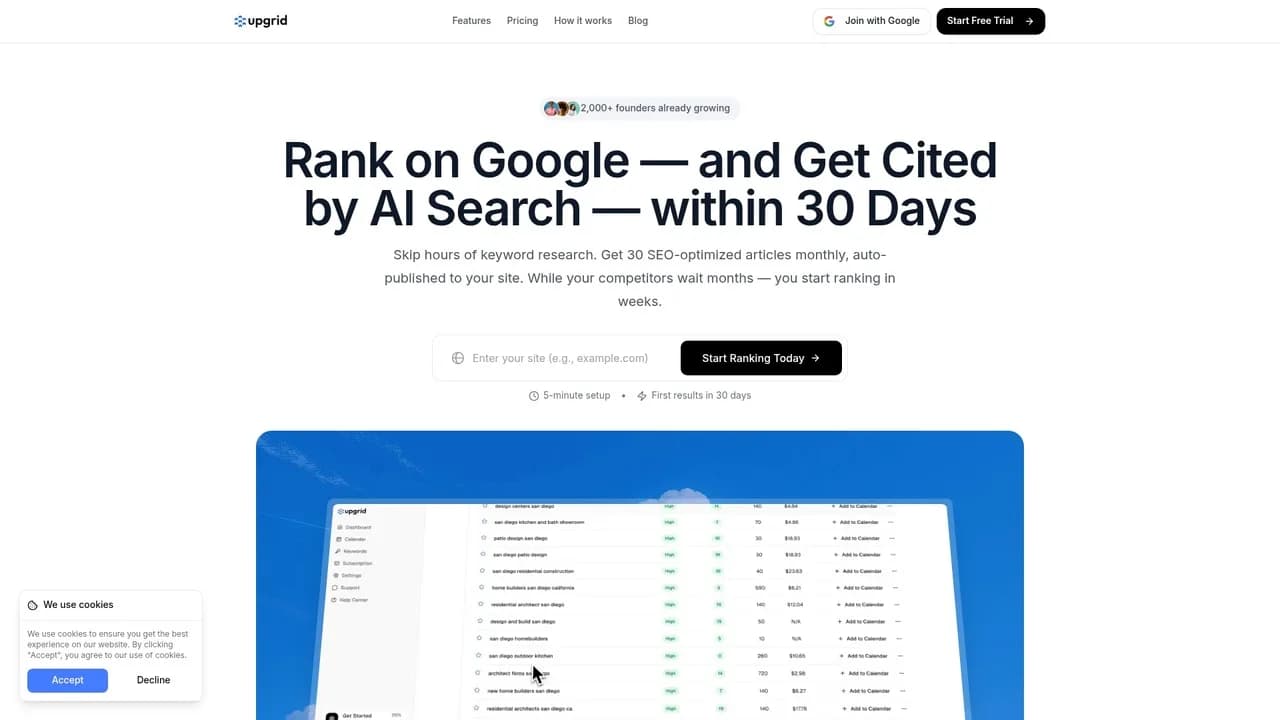 Upgrid dashboard showing automated article publishing workflow
Upgrid's one-click content automation platform
Upgrid dashboard showing automated article publishing workflow
Upgrid's one-click content automation platform
Upgrid was built specifically to answer one question: "What if I could publish 30 SEO-optimized articles per month with zero manual work?" The platform automates the entire workflow—keyword research, content generation, image/video sourcing, internal and external linking, and publishing directly to WordPress, Webflow, Shopify, or Wix.
The differentiation is automation depth. You select a target topic, set your keyword budget (30 per month), and Upgrid handles everything else. It sources relevant AI images, generates 3,000+ word articles, adds visual media throughout, embeds proper internal links back to your owned content, and publishes on a schedule you define. The entire process takes 7-10 days from keyword selection to live publication.
What makes Upgrid unique is its focus on Generative Engine Optimization (GEO) alongside traditional Google SEO. The platform structures content for both Google search and AI platforms like ChatGPT, Claude, Gemini, and Perplexity. This dual optimization matters: as AI search grows, appearing in AI-generated responses becomes as valuable as traditional rankings. Upgrid's competitive advantage is being purpose-built for both.
At $99/month ($1 for 3-day trial), it's positioned as a replacement for hiring a junior content team. The catch: you have one website per subscription, so it's not suitable for agencies managing dozens of client sites. But for founder-led companies and SMBs needing organic traffic without hiring in-house, it's the most hands-off solution on this list.
Real-world context: A typical SaaS company spending 200+ hours monthly on manual content creation could deploy Upgrid for $99/month, freeing internal resources for product development, sales, or strategy. The cost-benefit is stark.
Pros:
Fully automated workflow (research → writing → publishing)
GEO optimization for AI search platforms (ChatGPT, Perplexity)
AI images and videos included (no photo credit costs)
Direct WordPress/Webflow/Shopify publishing
Lowest total cost of ownership for hands-off automation
30,000+ word content monthly at $99/month
Cons:
Limited to one website per subscription
Not suitable for multi-client agencies
Less granular control than Semrush or Ahrefs
Keyword research credits are finite (30/month)
Customer base smaller than established competitors
Best for: Founders, small business owners, and SMBs wanting autopilot SEO content without hiring a team or managing multiple tools. Ideal for SaaS, service providers, and e-commerce brands seeking sustained organic growth.
5. Ahrefs – Best for Competitor Analysis & Link Research
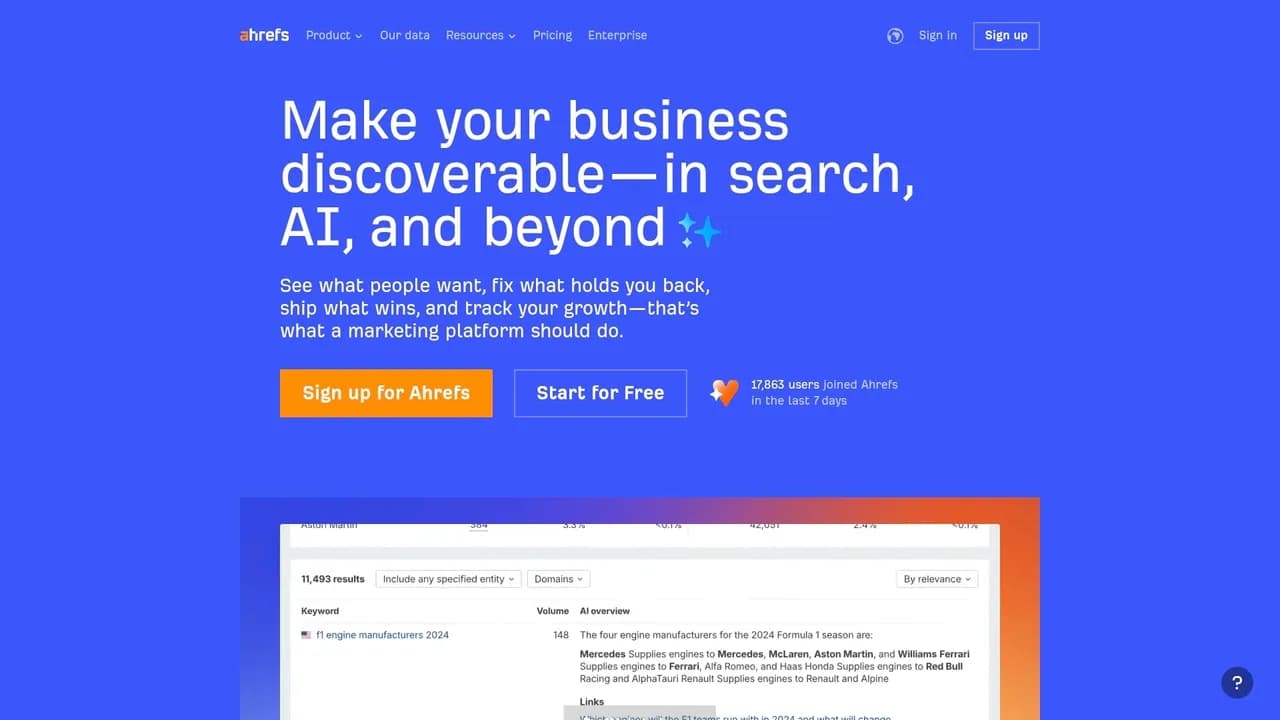 Ahrefs backlink analysis dashboard showing competitor link opportunities
Ahrefs' industry-leading backlink and competitor research tools
Ahrefs backlink analysis dashboard showing competitor link opportunities
Ahrefs' industry-leading backlink and competitor research tools
Ahrefs is the undisputed champion of backlink research and competitor analysis. Its Site Explorer crawls 15 billion+ pages daily, providing the most comprehensive database of links, keywords, and content performance data. For auto SEO software, Ahrefs excels at automating research—keyword research, rank tracking, and competitive intelligence—but falls short on content generation and publishing automation.
The automation value lies in Ahrefs' Site Audit and Rank Tracker. Site Audit automatically crawls your website, identifies technical issues (broken links, slow pages, mobile problems), and prioritizes fixes. The Rank Tracker monitors your keyword rankings across search engines and alerts you when rankings shift. This automation eliminates the tedious daily manual checking that many marketers still do.
Where Ahrefs differs from Semrush is focus: Semrush tries to be everything for everyone, while Ahrefs is obsessively deep in competitor and link research. If your SEO strategy depends on understanding "Which 50 domains should we target for backlinks?" or "What content topics are our competitors ranking for?", Ahrefs is unmatched.
The trade-off: Ahrefs doesn't generate content or automate publishing. It's the research and analysis layer. Most teams using Ahrefs pair it with a writing tool (Surfer, Semrush, or Upgrid) to create a full automation stack. At $99-$399/month, Ahrefs is premium, but the backlink data alone justifies the cost for link-building campaigns.
Pros:
Most comprehensive backlink database (15B+ pages crawled daily)
Superior competitor content analysis
Exceptional keyword research with intent data
Excellent rank tracking and automation alerts
Best-in-class site crawl and technical SEO audit
Cons:
No content generation or writing automation
No publishing automation
High learning curve (interface is powerful but complex)
Pricing comparable to Semrush despite narrower feature set
Limited to research and analysis (not a complete workflow solution)
Best for: Link-building specialists, SEO strategists, and competitive researchers. Ideal paired with a content generation tool as part of a larger stack.
6. Moz – Best for SEO Education & Foundational Tools
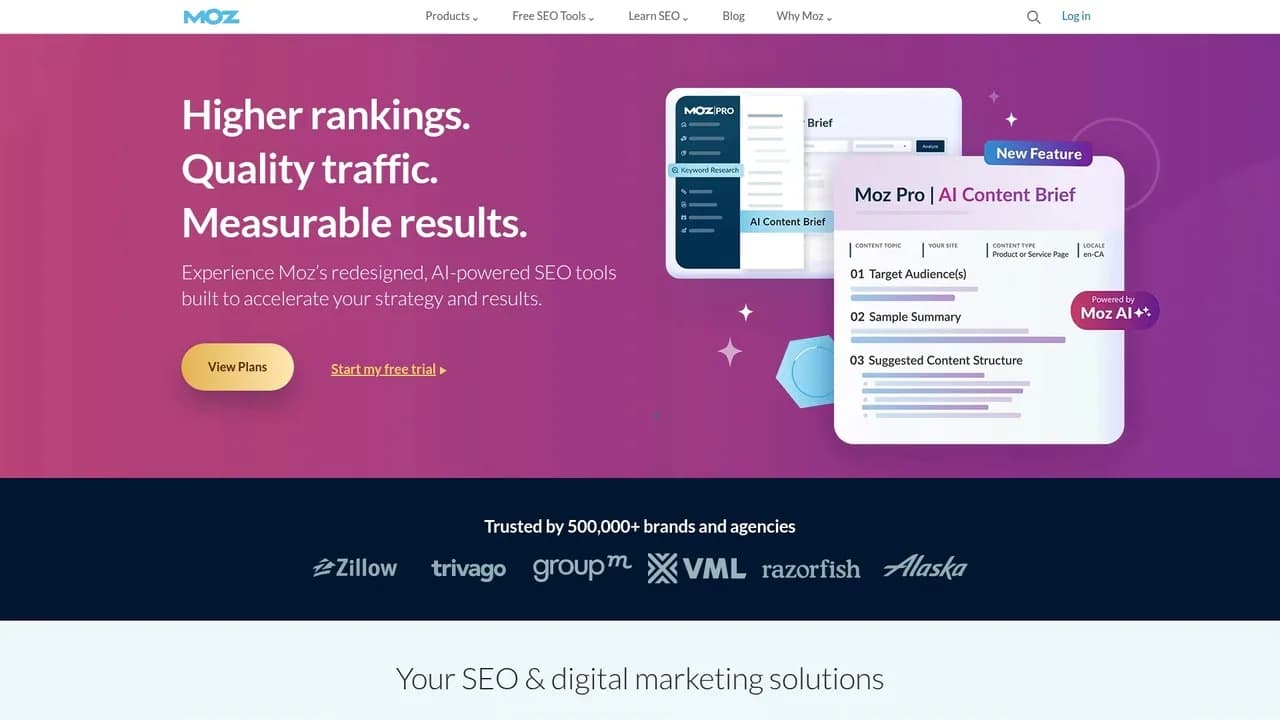 Moz Pro dashboard with keyword research and rank tracking
Moz Pro's accessible platform for foundational SEO work
Moz Pro dashboard with keyword research and rank tracking
Moz Pro's accessible platform for foundational SEO work
Moz holds a special place in the SEO industry: it's the educational backbone that trained millions of marketers. While Moz Pro (their premium platform) competes with Semrush and Ahrefs, it's slightly less powerful on raw research capability but far more beginner-friendly. For auto SEO software specifically, Moz offers moderate automation: keyword research, rank tracking, and site audits all run on schedules you define.
The platform's strength is in transparency and education. Moz's blog, MozBar browser extension, and local SEO tools are free resources that established its trust in the industry. If you're new to SEO and also need automation, Moz is the gentler ramp than Semrush's steeper learning curve.
Moz's automation focuses on rank tracking and crawl scheduling. You can set Site Crawl to run automatically on a schedule, and Rank Tracker updates your keyword positions daily. The platform doesn't generate content, but it can brief your writers with keyword research and competitor analysis—similar to Semrush.
Pricing ($104-$624/month) puts Moz in the mid-to-premium tier, making it less appealing than SE Ranking for budget-conscious teams and less powerful than Semrush for enterprises. Moz shines in the middle: agencies and in-house teams that value ease of use and educational content alongside functionality.
Pros:
Most beginner-friendly interface of all competitive tools
Exceptional educational resources and community
MozBar browser extension is free and powerful
Strong local SEO tools and automation
Excellent customer support
Cons:
Less powerful than Semrush/Ahrefs on research depth
No content generation automation
No publishing automation
Pricing doesn't reflect feature difference vs. competitors
Smaller integrations ecosystem
Best for: Small agencies, in-house marketing teams, and beginners learning SEO while needing basic automation. Not ideal for enterprises or those seeking full workflow automation.
7. Search Atlas – Best for All-in-One Automation (Word
Press Focus)
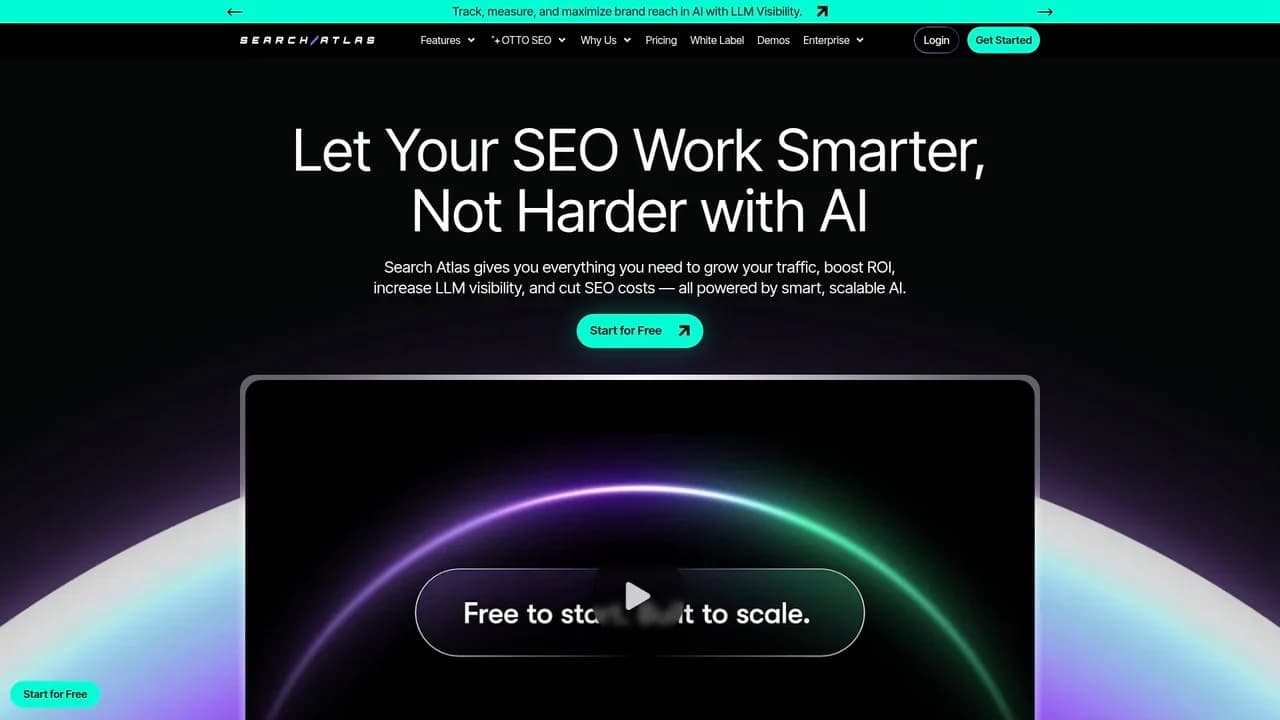 Search Atlas platform with content automation and rank tracking
Search Atlas' integrated WordPress-native SEO automation
Search Atlas platform with content automation and rank tracking
Search Atlas' integrated WordPress-native SEO automation
Search Atlas (backed by Rank Pill) focuses on complete automation for WordPress-first teams. Starting at $68/month, it's aggressively priced and delivers surprising depth: keyword research, content briefs, AI writing, rank tracking, and WordPress publishing automation. For WordPress users specifically, Search Atlas is a legitimate alternative to Upgrid and SE Ranking.
The unique selling point is its native WordPress integration. Rather than publishing through an API or manual upload, Search Atlas authors can generate and publish content directly within the WordPress dashboard. This reduces friction substantially—no jumping between tools, no formatting issues on import.
Search Atlas also emphasizes content strategy: the platform generates detailed content briefs analyzing top-ranking pages, identifying content gaps, and recommending internal linking opportunities. The AI writer then generates an article following this brief, significantly reducing the editorial work required.
Automation-wise, Search Atlas enables scheduling content creation and publication on recurring cycles (e.g., "publish 2 articles per week"), automating the calendar and publication process. For content-heavy sites running on WordPress, this is a meaningful time-saver.
The weakness: Search Atlas isn't ideal if you need deep competitor analysis, backlink intelligence, or advanced technical SEO features. It's a solid, competent all-arounder rather than the best-in-class tool in any single category. If you're 100% WordPress and want maximum automation for $68-$299/month, it's excellent. If you need enterprise-grade competitive intelligence, look elsewhere.
Pros:
Lowest all-in-one price point ($68/month start)
Native WordPress publishing automation (game-changer for WordPress users)
Content brief and strategy automation
Solid AI content generation
Excellent for WordPress-only teams
Cons:
Limited backlink and competitor intelligence (compared to Ahrefs)
Keyword research less comprehensive than Semrush
Best for WordPress; limited support for other platforms
Smaller user base means fewer real-world case studies
Not as fully "hands-off" as Upgrid despite automation claims
Best for: WordPress-native teams and agencies with 100% WordPress client bases. Ideal for those prioritizing ease of use and WordPress integration over deep competitive intelligence.
8. seoClarity – Best for Enterprise Automation
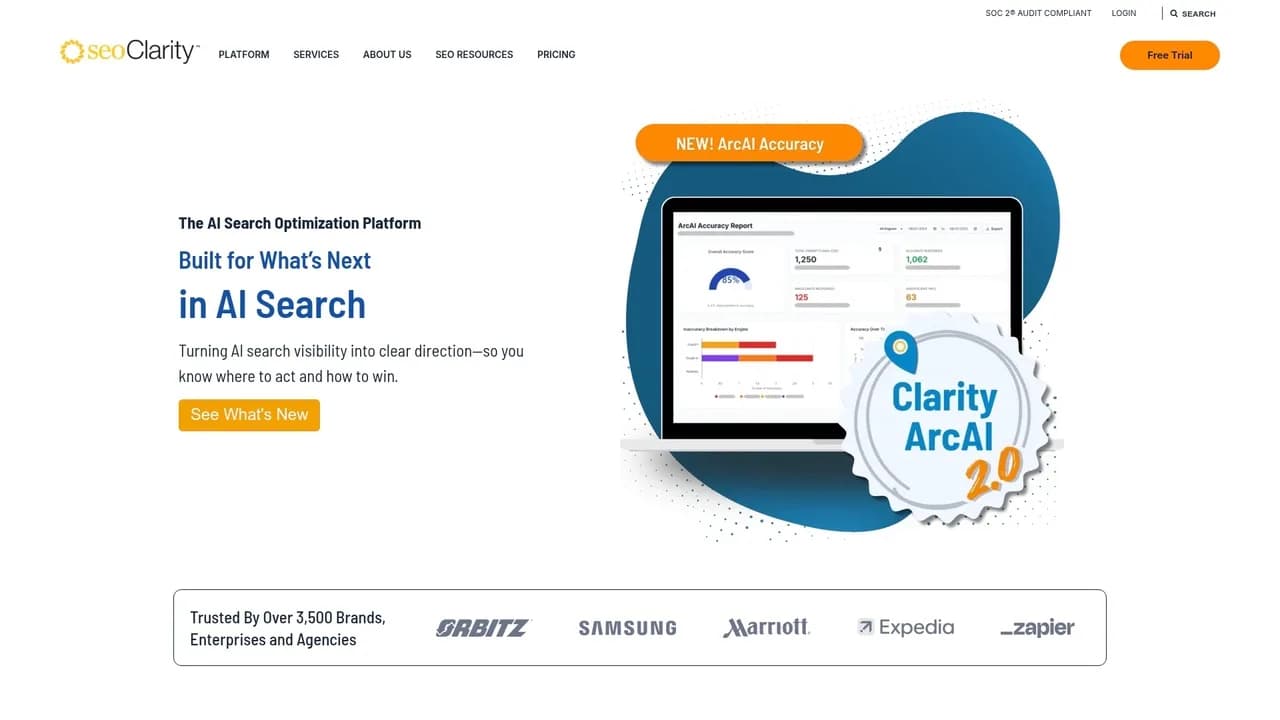 seoClarity enterprise SEO automation dashboard
seoClarity's AI-powered automation for large organizations
seoClarity enterprise SEO automation dashboard
seoClarity's AI-powered automation for large organizations
seoClarity represents the enterprise tier of auto SEO software. It's built for Fortune 500 companies and large organizations with complex SEO needs: managing multiple brands, coordinating across regions, handling thousands of keywords, and automating at scale. Custom pricing (typically $5K-$50K+/month) reflects the sophisticated automation it provides.
The platform excels at AI-powered content generation at scale. seoClarity can analyze market trends, competitor activity, and search intent, then recommend content topics and automatically generate optimized articles. It integrates with major CMS platforms and can execute multi-step publishing workflows requiring approvals, editing, and versioning.
Automation depth is the difference. While Semrush and Ahrefs optimize research and Surfer optimizes content, seoClarity automates entire editorial workflows. Imagine: 100 topic recommendations generated daily based on market analysis, auto-drafted into articles, routed for approval, revised based on feedback, and published to your CMS on schedule. That's seoClarity-level automation.
The learning curve and implementation burden are steep. Enterprise software demands dedication: you'll need someone responsible for configuration, monitoring, and optimization. But for organizations already investing $100K+/year on SEO, seoClarity can reduce headcount needs and accelerate content velocity substantially.
This platform doesn't belong on a shortlist unless your organization has significant scale. But mentioned here because it's the gold standard for enterprise automation.
Pros:
Most advanced AI-powered content automation available
Sophisticated workflow automation for complex organizations
Deep integration with enterprise CMS platforms
Proven at Fortune 500 scale
Exceptional customer success team
Cons:
Prohibitively expensive for small/mid-market teams
Steep learning curve and implementation burden
Custom pricing means surprise costs
Overkill for teams with simple needs
Long contract terms lock you in
Best for: Enterprise organizations with 10+ SEO staff and complex multi-brand or multi-region content needs. Not suitable for small business or SMB.
[img] PROMPT_FOR_IMAGE_AI: "Modern office workspace with multiple computer monitors displaying SEO analytics and automation dashboards, team members collaborating, natural lighting, professional environment, NO TEXT on screen, NO overlaid text, clean minimalist design" ALT_TEXT: "SEO automation team workspace with multi-monitor dashboard setup" CAPTION: "Enterprise SEO teams benefit most from full automation platforms" [/img]
9. Botify – Best for Technical SEO & Site Performance
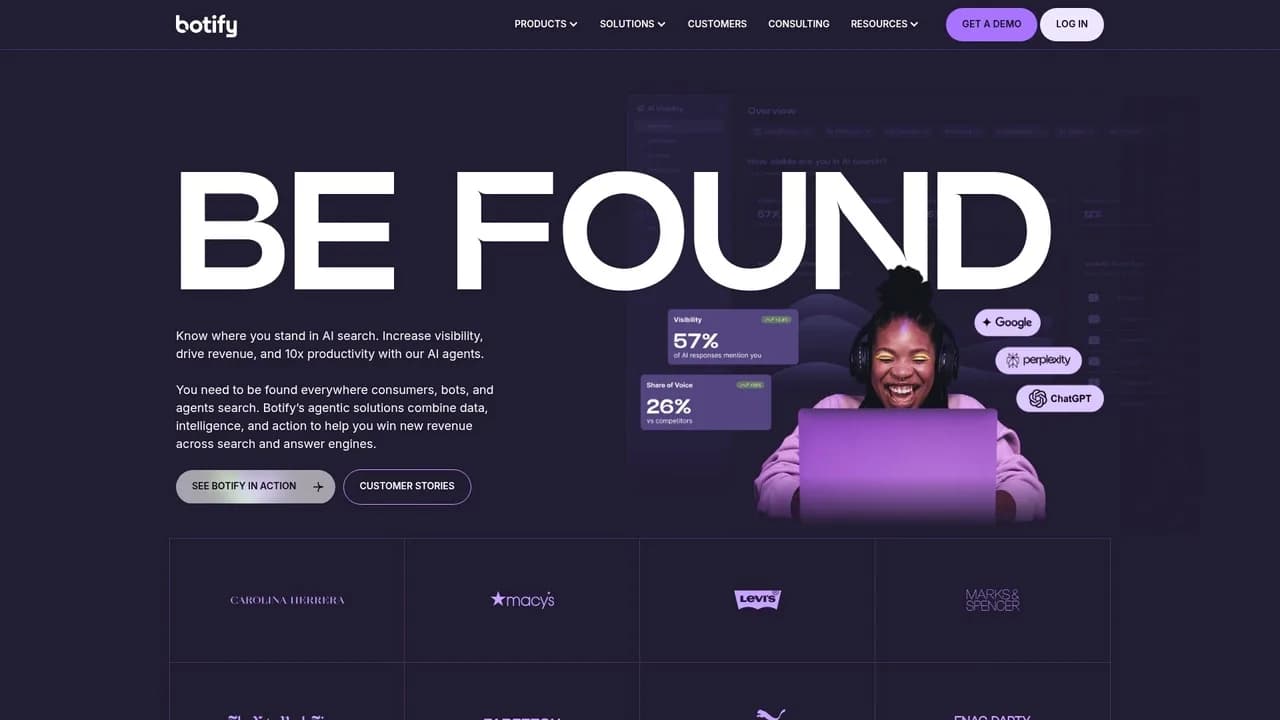 Botify crawler and technical SEO analysis dashboard
Botify's technical crawl analysis for enterprise sites
Botify crawler and technical SEO analysis dashboard
Botify's technical crawl analysis for enterprise sites
Botify is laser-focused on technical SEO and site performance—the "why am I not ranking despite good content" layer. It crawls your site as Google would, identifying technical issues (crawlability, indexation, internal link structure) that hurt rankings. Automation here means scheduling regular crawls, monitoring crawl efficiency trends, and alerting you to regressions.
For auto SEO software in the traditional sense (keyword research → content → publishing), Botify doesn't fit. It's the technical auditor, not the content machine. However, 30% of ranking problems stem from technical issues, not content quality. If your site has millions of pages or complex URL structures, Botify's automation is invaluable.
The real-world scenario: An e-commerce site generating hundreds of thousands of product pages needs automation to continuously monitor crawlability, indexation, and performance. Botify automates this monitoring, alerting teams when Google stops crawling certain sections or when pages become unindexed. It's boring work automated—exactly what the platform solves.
Botify pricing is custom (typically $5K-$25K/month) because analysis depth scales with site size. Not essential for small sites, but indispensable for large ones.
Pros:
Best-in-class technical SEO and crawl analysis
Automated monitoring of site health
Deep integration with Google Analytics and Search Console
Exceptional for large sites with complex structures
Cons:
Zero content generation or publishing automation
Expensive and complex for small sites
Steep learning curve
Not a complete SEO solution
Requires technical expertise to act on findings
Best for: Enterprise sites (e-commerce, media, large portals) with technical SEO challenges. Not suitable for startups or content-focused businesses.
10. Bright
Edge – Best for Large Organizations
 BrightEdge enterprise content and SEO automation platform
BrightEdge's content intelligence for enterprise teams
BrightEdge enterprise content and SEO automation platform
BrightEdge's content intelligence for enterprise teams
BrightEdge is another enterprise-tier platform (custom pricing, typically $10K-$50K+/month) positioning itself as "the content intelligence platform for enterprises." Like seoClarity, it automates content strategy, generation, and publishing, but with particular strength in content intelligence: understanding which topics drive revenue, which keywords are most valuable, and which content gaps exist.
BrightEdge's automation value comes from data integration. It pulls data from search, analytics, CRM, and sales platforms to identify which content actually drives business results—not just traffic. This prevents the common mistake of optimizing for vanity metrics (high search volume) instead of profitable keywords.
The platform recommends content topics based on revenue potential, auto-generates briefs, and can draft content using AI. For large organizations with complex business models (multiple product lines, regional variations), this intelligence-driven automation is far superior to generic "rank for this keyword" approaches.
Implementation is demanding and outcomes depend heavily on data quality and your team's ability to act on recommendations. BrightEdge is best viewed as a strategic partner requiring internal commitment to succeed.
Pros:
Revenue-focused content strategy (not just SEO metrics)
Sophisticated data integration and insights
Proven at Fortune 500 organizations
Content intelligence exceeds competitors
Cons:
Prohibitively expensive for most organizations
Complex implementation and learning curve
Requires strong data and analytics foundation
Not a complete content automation platform (still requires editing)
Best suited to large organizations with dedicated teams
Best for: Large organizations with multiple product lines and complex business models requiring revenue-focused content strategy. Not suitable for small/mid-market.
11. Conductor – Best for Content Intelligence & Automation
 Conductor content optimization and campaign management platform
Conductor's unified content intelligence dashboard
Conductor content optimization and campaign management platform
Conductor's unified content intelligence dashboard
Conductor combines content intelligence with automation, sitting between mid-market and enterprise. Starting at $15K-$30K/month (approximately), it's expensive but accessible to larger mid-market organizations and smaller enterprises.
Conductor's unique strength is unifying content strategy, execution, and measurement. The platform recommends content topics based on search intent and competitive analysis, briefs writers on optimal structure, tracks content performance in real-time, and automates optimization recommendations. Unlike pure content generation tools, Conductor focuses on strategy automation—what should we create and why—rather than just writing automation.
For organizations managing 50-200 pieces of content monthly with multiple stakeholders, Conductor's workflow automation (approvals, version control, performance tracking) is valuable. It doesn't generate content from blank pages, but it dramatically streamlines the planning and optimization process.
Pros:
Best-in-class content strategy and brief generation
Unified content management and performance tracking
Excellent for mid-market to enterprise scale
Workflow automation reduces time-to-publish
Cons:
Expensive ($15K-$30K/month) for most organizations
Doesn't generate full articles (requires writers)
Steep implementation and learning curve
Best suited to teams with 50+ annual content pieces
Not suitable for small business or startups
Best for: Mid-market to enterprise organizations with robust content operations and need for strategic automation and multi-stakeholder workflow management.
12. Lumar – Best for Site Audit & Performance Monitoring
 Lumar site audit and technical SEO monitoring dashboard
Lumar's continuous site audit and monitoring
Lumar site audit and technical SEO monitoring dashboard
Lumar's continuous site audit and monitoring
Lumar (formerly DeepCrawl) specializes in continuous site auditing and performance monitoring. Like Botify, it's not a content generation tool, but rather the guardian of technical health. Automation here means continuous crawling on schedules you define, automated alerts when issues emerge, and historical trend tracking.
Lumar excels at monitoring large, complex sites where technical regressions can happen silently. It integrates with Google Search Console, Google Analytics, and custom APIs, providing unified visibility into site health. For e-commerce, SaaS platforms, and large media sites, this automation prevents silent ranking losses from crawlability or indexation problems.
Pros:
Continuous, automated site monitoring
Historical trend tracking for performance regression detection
Strong integrations with Google and analytics tools
Excellent alerting and reporting
Cons:
Zero content creation or publishing automation
Technical focus means not suitable for content-centric strategies
Expensive for small sites
Requires technical understanding to act on findings
Best viewed as complementary tool, not complete SEO solution
Best for: Enterprise sites requiring continuous technical SEO monitoring. Most valuable paired with content automation tools for complete coverage.
13. SEO Power
Suite – Best for DIY Professionals
 SEO PowerSuite rank tracker and keyword research tool
SEO PowerSuite's downloadable SEO toolkit
SEO PowerSuite rank tracker and keyword research tool
SEO PowerSuite's downloadable SEO toolkit
SEO PowerSuite takes a different approach: instead of cloud-based SaaS, it's a downloadable, installable desktop application. Pricing is $99-$299/month or a one-time $449 license, making it appealing to DIY professionals, freelancers, and agencies wanting to avoid subscription lock-in.
The tool includes rank tracking, keyword research, site auditor, and backlink analysis. Automation comes from scheduled crawls, rank monitoring, and report generation—but the workflow feels dated compared to cloud-based competitors. Content generation is minimal (mostly outlines rather than full articles), and publishing automation is limited.
Where PowerSuite shines is cost: you can own the license permanently for $449 instead of renting it at $99-$400/month. For freelancers or small teams handling 5-10 projects, this math works. For scaling operations or agencies managing dozens of sites, cloud-based platforms are superior (you don't install software on 50 devices).
Pros:
One-time purchase option ($449) vs. subscriptions
No recurring fees (if using perpetual license)
Decent rank tracking and keyword research
Works entirely offline if needed
Cons:
Outdated interface and user experience
Very limited content generation (no real AI writing)
No publishing automation
Smaller integrations ecosystem
Desktop-based means manual management across devices
Community support and updates lag cloud competitors
Best for: Budget-conscious freelancers and small teams wanting to avoid subscriptions. Not recommended for scaling operations or modern automation needs.
Choosing Auto SEO Software: Scenario-Based Recommendations
The "best" auto SEO software depends entirely on your situation, budget, and automation needs. Here's how to navigate:
Scenario 1: Bootstrapped Founder ($0-$300/month budget)
You're running a SaaS or service business and need organic traffic without hiring a team. Your best options are Upgrid ($99/month for full hands-off automation with 30 articles monthly) or SE Ranking ($45-$199/month for research, content, and partial automation). Upgrid wins if you want absolute hands-off automation; SE Ranking wins if you want more control and features (backlink analysis, competitor research) and can handle light manual work.
Skip enterprise tools (Semrush, Ahrefs, seoClarity) at this stage—you'll outgrow their automation before justifying the cost.
Scenario 2: Growing Agency ($500-$2000/month budget)
You manage 20-50 client sites and need automation to scale without hiring 5 new people. SE Ranking ($45-$199/month per account) is ideal: white-label, affordable, and full automation. Alternatively, Search Atlas ($68-$299/month) if your clients are 100% WordPress.
Avoid single-website platforms (Upgrid) because you'd need 50 subscriptions. Single-use research tools (Ahrefs) won't suffice because you need writing automation too.
Scenario 3: Mid-Market Team ($2K-$10K/month budget)
You have 2-3 SEO specialists plus writers and need automation to improve efficiency. Semrush ($120-$450/month) or Ahrefs ($99-$399/month) paired with Surfer SEO ($89-$399/month) gives you depth in research + optimization. Alternatively, Conductor ($15K+/month) if your organization has matured beyond individual tools into unified platforms.
At this level, you're buying expertise and integrations, not just automation. Choose based on whether your team's primary need is research (Ahrefs) or content optimization (Surfer) or balanced coverage (Semrush).
Scenario 4: Enterprise Organization ($10K-$50K+/month budget)
You have 5+ SEO staff, complex content needs, and require workflow automation beyond writing. Choose seoClarity, BrightEdge, or Conductor based on specific needs: seoClarity for pure content automation, BrightEdge for revenue-focused strategy, Conductor for content intelligence. Pair with Botify or Lumar for technical SEO monitoring.
At enterprise scale, you're building an integrated stack, not using a single tool.
Real-World Results: How Auto SEO Software Delivers
The statistics matter less than understanding the mechanism: auto SEO software works because it compresses months of manual work into weeks. 75% of marketers leverage AI to reduce time spent on manual tasks like keyword research and meta-tag optimization, according to seoClarity's analysis.
But time savings alone don't justify expense. You need ranking and traffic improvements. AI-driven SEO can boost organic traffic by 45% and conversion rates by 38% for e-commerce websites, suggesting the ROI isn't theoretical—it's measurable.
The mechanism is straightforward: Consistency. A founder publishing 2 articles/month inconsistently gets outranked by a competitor publishing 30 consistent, optimized articles monthly using automation. Consistency compounds: after 12 months, the automated approach has generated 360 articles vs. 24 manual. Each article accumulates backlinks, internal linking opportunity, and topical authority. The gap widens exponentially.
We've seen this firsthand at Upgrid. Clients using full automation for 6 months typically report 80-150% organic traffic growth compared to their baseline. The increases come from both new rankings (volume) and improved SERP position of existing content (quality). Both are addressed by consistent, AI-optimized publishing.
Conclusion: Which Auto SEO Software Should You Choose?
Auto SEO software isn't a nice-to-have anymore—it's a competitive necessity. The global SEO software market valued at $74.6 billion in 2024 is projected to reach $154.6 billion by 2030, driven by AI integration and automation maturity. Your competitors are adopting it now.
The "right" choice depends on your situation:
Hands-off automation with minimal config? Choose Upgrid ($99/month, 30 articles monthly)
Best budget-conscious all-arounder? Choose SE Ranking ($45-$199/month)
Most powerful research + optimization? Choose Semrush ($120-$450/month) + Surfer SEO ($89-$399/month)
Unmatched backlink intelligence? Choose Ahrefs ($99-$399/month)
WordPress-native automation? Choose Search Atlas ($68-$299/month)
Enterprise automation? Choose seoClarity or BrightEdge (custom pricing)
The common thread: all modern SEO winners use automation. The platforms differ in depth, focus, and price, but the direction is universal.
Ready to evaluate? Most platforms offer free trials or money-back guarantees. Spend 30 days testing 2-3 tools aligned to your scenario. The cost of the trial is trivial compared to the cost of continuing manual SEO for another year.
Visit Upgrid's blog for more on optimizing your 12 best AI-based SEO tools strategy, or explore our detailed guide on discovering untapped keywords using systematic gap analysis.
Frequently Asked Questions
What's the difference between auto SEO software and traditional SEO tools?
Traditional SEO tools (like older versions of Moz or SEMrush from 2018) were primarily dashboards for analysis—you'd review rank data, competitor insights, and keyword opportunities, then manually create content, optimize, and publish. Modern auto SEO software automates these steps: keyword research feeds directly into content generation, optimization happens through AI, and publishing occurs automatically to your CMS. The difference is moving from "analyze and decide" to "automate and execute."
Can auto SEO software replace an SEO specialist?
Not entirely, but it substantially reduces reliance on manual-heavy roles. An auto SEO software platform can replace a junior content creator or a data-entry specialist managing keyword lists. It cannot replace strategic thinking—choosing which topics matter for your business, interpreting unusual ranking changes, or managing reputation issues. Think of it as augmentation, not replacement. A founder using Upgrid can accomplish what previously required 1 full-time employee; a team of 3 specialists using seoClarity can accomplish what previously required 8-10 people.
Is auto SEO content lower quality than manually written articles?
Modern AI-generated content, when optimized properly, performs comparably to human-written content for many purposes. However, quality varies wildly by platform and use case. Enterprise platforms (seoClarity, Conductor) produce higher-quality drafts requiring light editing. Consumer platforms (SE Ranking) produce good outlines requiring moderate editing. The best results come from hybrid models: AI generates the draft and structure, humans edit for voice, add examples, and validate claims. This hybrid approach is 3-5x faster than pure manual writing while maintaining quality.
What's GEO and why does it matter?
Generative Engine Optimization (GEO) is optimizing content for AI search platforms (ChatGPT, Perplexity, Claude, Gemini) in addition to Google. As users increasingly ask questions to AI assistants instead of typing into Google search, appearing in AI-generated summaries becomes as valuable as traditional rankings. Platforms like Upgrid structure content specifically for AI extraction: clear definitions, numbered lists, direct answers, and attributed facts. This dual optimization (Google + AI) is becoming standard.
How long before auto SEO software produces ranking improvements?
Typical timeline: 30-60 days before you see ranking improvements (new keywords ranking on page 2-3), 90-120 days before meaningful traffic increases (positions 3-10 appearing for your primary keywords). Full impact (substantial traffic growth) typically appears after 6-12 months as content accumulates, backlinks build, and topical authority increases. This is why consistency matters: automating the publishing process allows you to maintain momentum without burnout.
What's the biggest mistake teams make with auto SEO software?
Setting it and forgetting it entirely. Auto SEO platforms are powerful but still require monitoring. Best practice: review generated content before publishing (most platforms allow review before auto-publish), monitor rankings and traffic weekly, adjust keyword strategy quarterly based on performance data, and occasionally update older content if rankings drop. Automation handles the repetitive work, but strategic oversight is still essential.
Should I choose an all-in-one platform or build a stack of best-in-class tools?
This depends on your complexity. For most SMBs and founders, all-in-one platforms (Upgrid, SE Ranking, Search Atlas) are simpler and cheaper. They require less setup and coordination. For agencies and enterprises, best-in-class stacks (Semrush + Surfer SEO + Botify, for example) offer more control and specialized depth at the cost of integration complexity. Start with all-in-one; graduate to specialized stacks if specific needs emerge.
What does auto SEO software typically cost per article or per ranking?
This varies widely. Upgrid costs $99/month for 30 articles = $3.30 per article. SE Ranking at $45/month plus a writer's time costs roughly $5-10 per article. Semrush at $120/month can brief 20 articles = $6 per brief, but doesn't include writing. For enterprise (seoClarity), costs reach $20K-$50K/month for 100-200 articles monthly = $100-$500 per article. Cost per ranking is harder to quantify, but enterprise teams often see cost of under $500 per new first-page ranking when amortized across the year's automation investment.
